Add new project
This guide explains how to add a new project in Karelics Cloud.
Projects help you organize robot operations under a specific location, client, and timeframe.
1. Start in Admin Hub
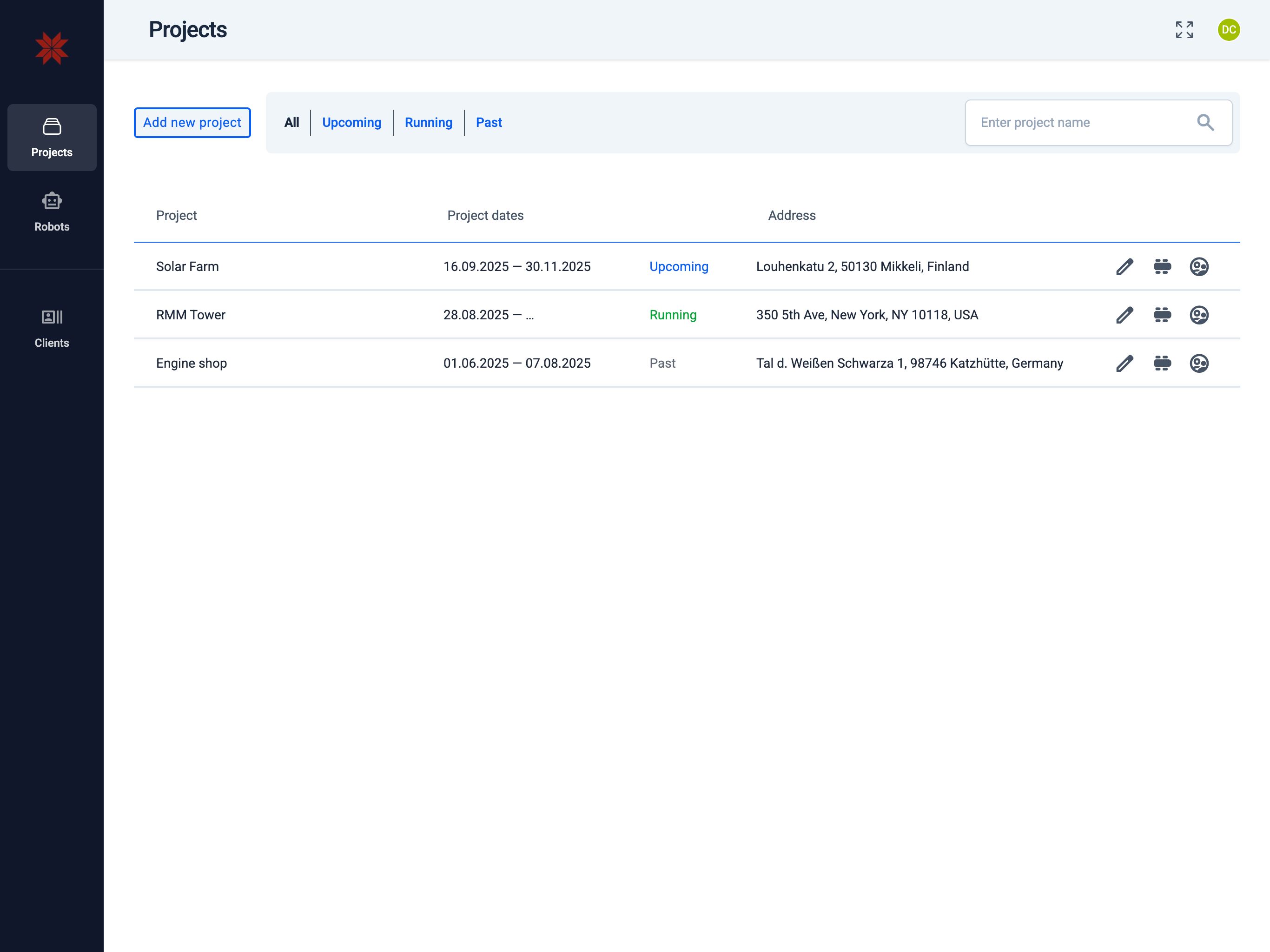
- Open the Admin Hub.
- Click Add new project.
Fill in General Information
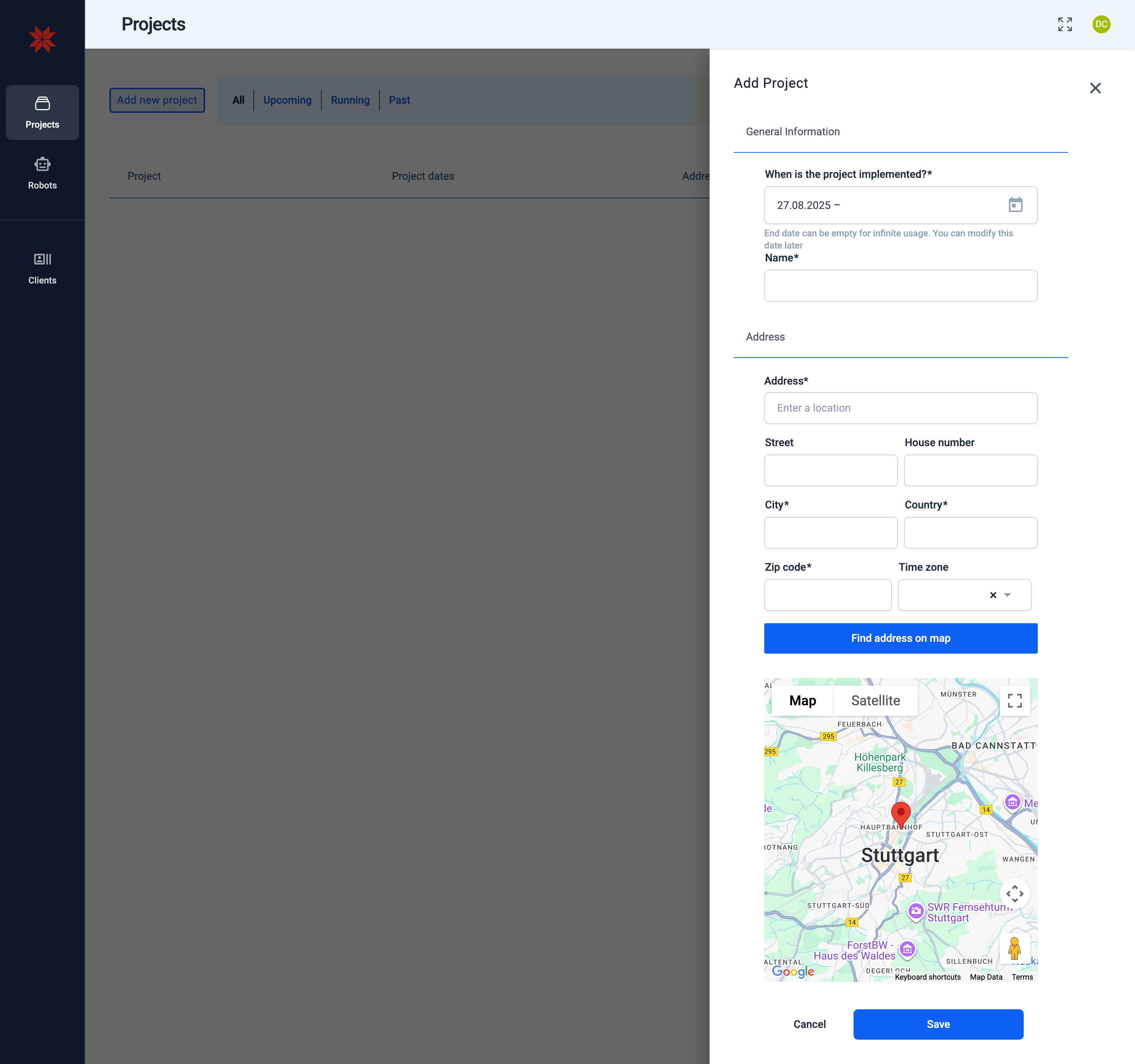
When you add a new project, you can fill in the following fields:
- When is the project implemented?
- Select the project start date from the calendar.
- The end date can be left empty for continuous usage.
- You can modify these dates later if needed.
- Name
- Enter a descriptive name for your project (e.g., Stuttgart Inspection 2025).
- Fill in the address details:
- Address (location name)
- Street and House number
- City and Country
- Zip code
- Time zone
- Use the Find address on map button to automatically locate the project on the map.
- Verify the red pin is correctly placed on the map.
Save the Project
- Click Save to create the project.
- The new project will now appear in the project list under Upcoming, Running, or Past, depending on the selected dates.
Karelics Cloud allows you to manage multiple projects at the same time.
This helps you organize operations across different sites, clients, or time periods without mixing data.
Learn more on the Multi‑Project Support page.
2. Configure Module Library
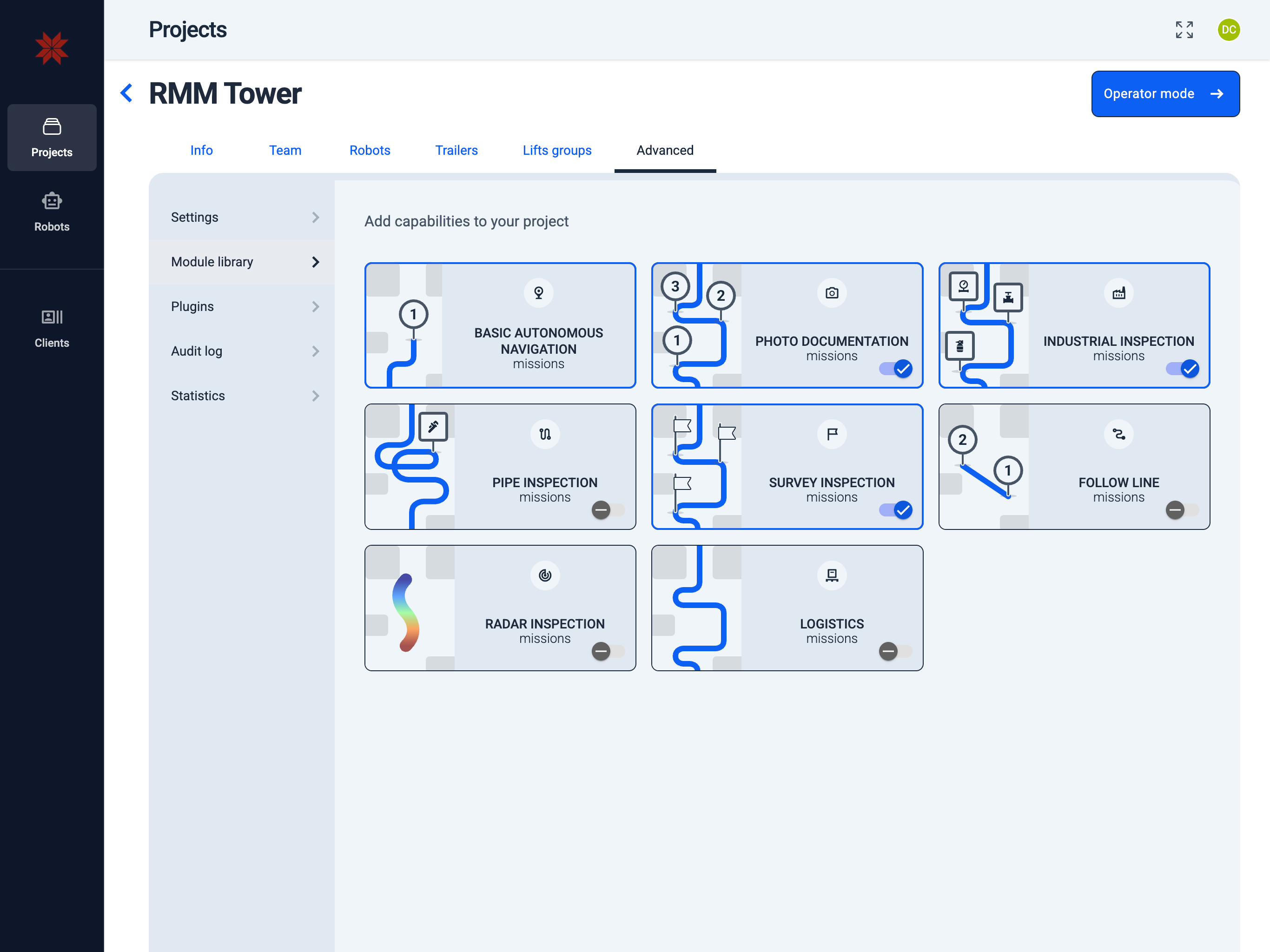
Admin Hub → Projects → Current Project → Advanced → Module Library
Add capabilities to the project by managing project‑specific modules available for your robots.
3. Configure Project Team
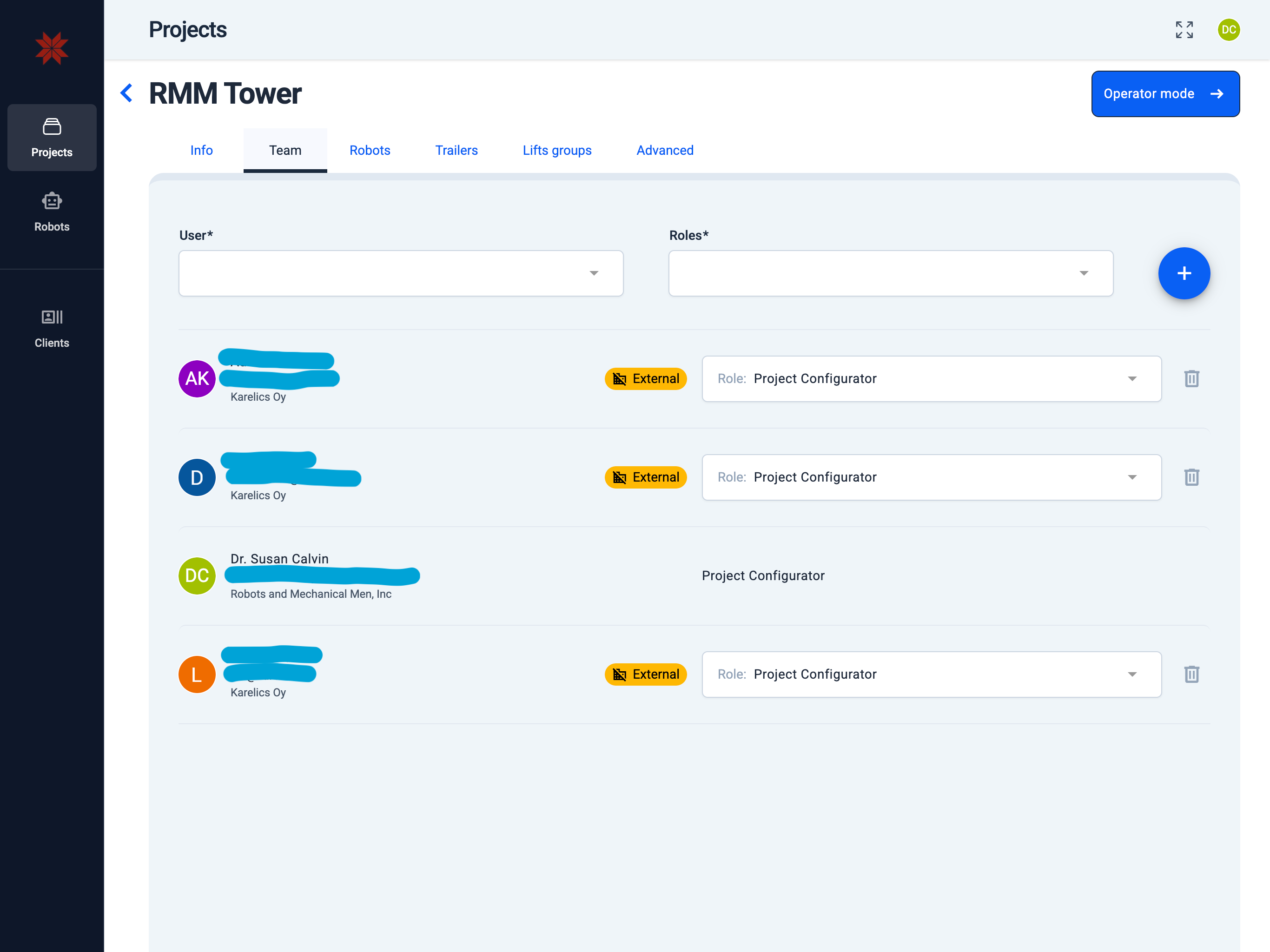
Admin Hub → Projects → Current Project → Project Team
The Project Team permission management includes all members of your company. Depending on the assigned role, members can manage that project and its assets.
You can invite, remove, and assign roles to users from your company, and to users from other companies (external).
What each role can do:
| Role (description) | Read project / project.read_project | Update project / project.update_project | Manage users / project.manage_user | Invite users / project.invite_user | Assign device / project.assign_device | Operate device / project.operate_device | Manage maps / project.manage_map | Manage map data / project.manage_map_related_data |
|---|---|---|---|---|---|---|---|---|
| Project Configurator — Views project; edits maps; operates devices; manages map data & users | ✅ | ✅ | ✅ | ✅ | ✅ | ✅ | ✅ | ✅ |
| Project Manager — Views project; operates devices; manages map data & users | ✅ | – | – | ✅ | – | ✅ | – | ✅ |
| Project Device Operator — Views project; operates devices; manages map data | ✅ | – | – | ✅ | – | ✅ | – | ✅ |
| Project Viewer — Views project (devices, maps, positions, related data) | ✅ | – | – | – | – | – | – | – |
The Project Team permission management includes all members of your company. Depending on the assigned role, members can manage that project and its assets.
Learn more in the Permission management page.
4. Configure Project AI Settings
Admin Hub → Projects → Current Project → Advanced → Settings
Configure project‑level options.
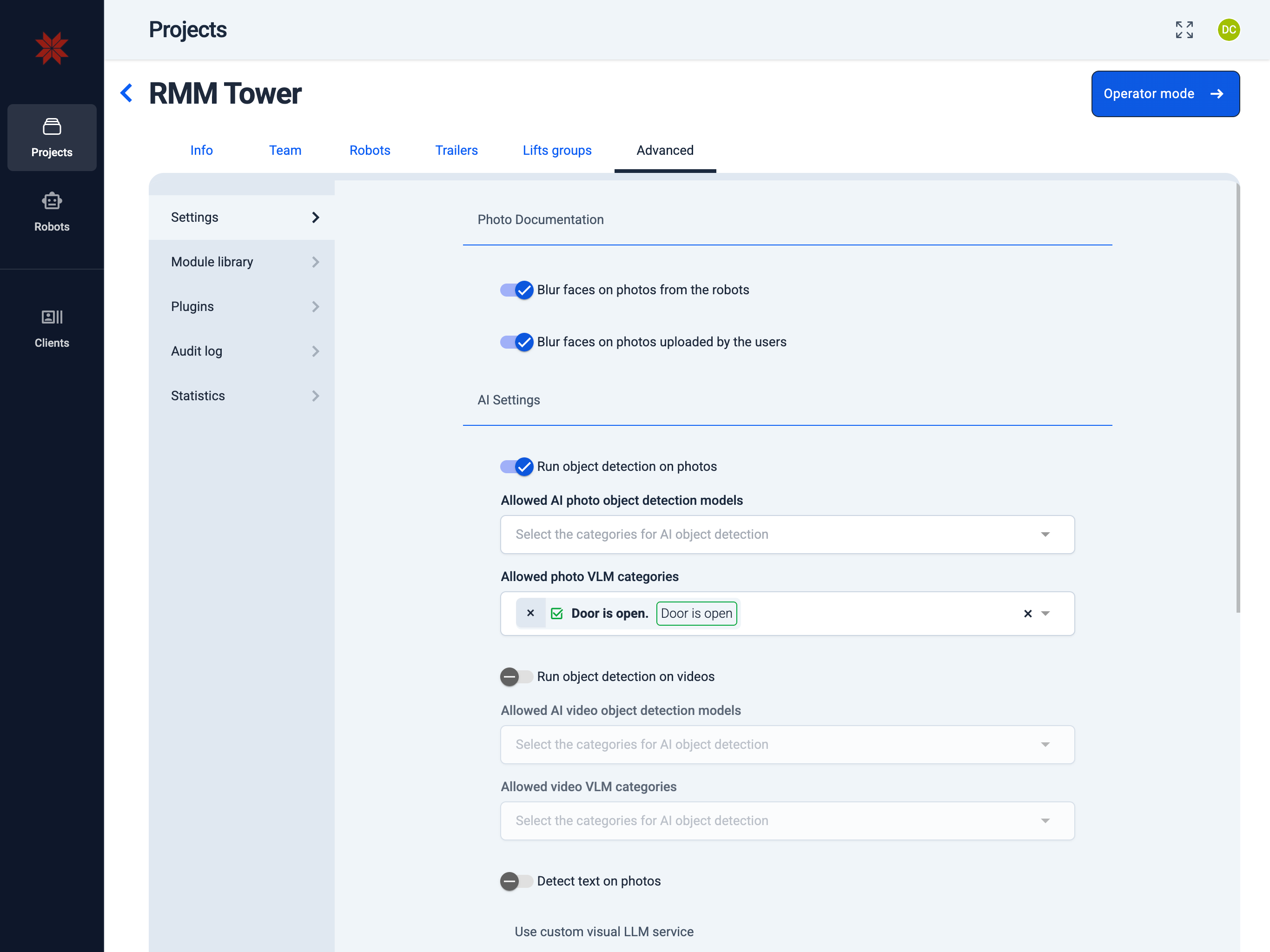
Photo Documentation
Toggle automated face blurring for assets captured by robots or uploaded by users. When enabled, the system anonymizes detected faces before the files appear anywhere else in the project.
Existing photos remain unchanged; only new uploads (or captures) are processed after the toggle is turned on.
AI Settings
Run object detection on photos — scans new images and tags them with the selected AI annotation categories. Disable the toggle to skip photo-level AI processing.
Run object detection on videos — performs the same classification for uploaded videos when enabled. Use the dropdown to restrict detections to the categories relevant to the project.
Custom visual LLM service
Provide the Service URL, Model name, and API key to override the built-in AI engine. Once configured, all image and video detections for this project run through the connected provider.
Reporting
Activate the hourly newsletter to email AI detection summaries. Choose which annotation categories should appear in the digest and list the recipients who need the updates.
5. Switch to Operator Mode
After configuring your project settings, you can switch to Operator Mode to start managing your project operations.